

By Tamanisha John
Between December 5-7, 2023, in San Antonio, Texas navy planners from america, Canada, Barbados, and different CARICOM entities met to make plans for Tradewinds ’24. There, it was decided that the thirty ninth iteration of Train Tradewinds (EXTW24) would happen, a minimum of within the first part, in Barbados. Between January 29, 2024, and February 2, 2024 navy planners met once more, this time in Barbados, to survey the terrain for EXTW24.

EXTW24 will likely be co-hosted by Barbados and US Southern Command (SOUTHCOM) from Could 4, 2024 to Could 16, 2024. 13 impartial international locations, 5 territories, the US, UK, France, Canada, and the Netherlands – in addition to over 60 completely different organizations are anticipated to take part in EXTW24, and, in accordance with the Barbados, EXTW24 will put together Caribbean areas for the ICC Cricket World Cup 2024. That is according to the rebranding of those workouts as ‘culturally’ and ‘regionally’ related, alongside the conventional description of the train to assist US safety pursuits and targets in “its hemisphere.”
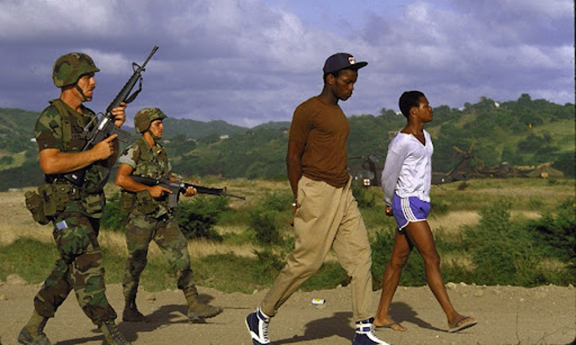
Train Tradewinds, originating as a “regional” tactic train, holds historic significance for its function in countering Caribbean revolutionary fervor and fostering hostility in the direction of Caribbean self-determination. Stemming from a US-led operation in Grenada in 1983, it expanded in 1986-87, involving conservative Caribbean allies. Regardless of its retroactive affiliation, the interval of 1984-87 primarily showcased militaristic shows geared toward undermining leftist governments within the area. This train, involving international locations like Barbados, Dominica, and later Jamaica, sought to suppress left-leaning actions within the Caribbean and Central America. Understanding its origins and targets is essential in comprehending its affect on regional politics and solidarity.

Train Tradewinds was not formally named till after 1988, a product of the post-Grenada invasion interval and the policing basis that was constructed within the Caribbean throughout it. From the invasion of Grenada in 1983, the US and its conservative Caribbean companions collaborated on coaching police and paramilitary forces within the Caribbean, constructing police infrastructure in a number of Caribbean islands for the only function of coaching in counterinsurgency to maintain political governance within the area reasonable or conservative and to forestall anti-colonial and anti-imperial actions from gaining traction.
Though the New Jewel Motion (NJM) overthrew the Gairy regime in Grenada in 1979 – the Reagan administration remained extra firmly dedicated to attacking communists, nationalist, and different kinds of anti-capitalist resistance in Central America (Panama, Nicaragua, Costa Rica, Honduras, El Salvador). Even so, the US would agree to increase cash to Caribbean states for safety, it was at all times on credit score or loaned phrases.
Following Grenada’s alignment with Marxist-Leninist ideologies and help from Cuba and the Soviets, US safety funding shifted. In 1981, post-Gairy regime overthrow, US Forces-Caribbean initiated paramilitary coaching for six Caribbean police forces. A 12 months later, forward of the Grenada invasion, the US navy and FBI skilled Caribbean police. Supported by US-trained OECS international locations (Antigua and Barbuda, Dominica, Montserrat, St. Lucia, St. Kitts and Nevis, St. Vincent and the Grenadines) and CARICOM allies (Barbados, Jamaica), the invasion occurred. Each CARICOM states had been led by conservative prime ministers aligned with Reagan: Tom Adams and Edward Seaga in Barbados and Jamaica, respectively.
Though presently there have been legal guidelines within the US which barred US help for international police, an exception was made for the Jap Caribbean, the place every police pressure – particularly for smaller islands like St. Kitts – had been made to have Particular Service Items (SSU), functionally paramilitary items, whereby they may obtain coaching in greater states like Barbados. Thus, previous to the invasion of Grenada in1983, the US navy and FBI had been explicitly coaching Caribbean law enforcement officials in techniques to subvert Black Energy Actions within the area recognized by the US and conservative Caribbean leaders as terrorists.
Three months after the invasion of Grenada, thus the beginning of 1984, Barbados prime minister Tom Adams continued to make the case for regional safety with the US on the helm. Headlines in January and February of 1984 regularly mentioned the Caribbean area as constructing a “mini-NATO”. That the US could be on the helm of Caribbean safety was made clear in 1984, when Commonwealth Secretary-Normal Sonny Ramphal tried to get US troops out of Grenada in order that the “peacekeeping” forces there have been solely composed of Caribbean police. Nevertheless, Ramphal was opposed by these conservative Caribbean governments.
Within the post-invasion Caribbean, states opposing intervention discovered themselves outnumbered by conservative governments favoring elevated US militarization for political stability. Regardless of US help, financial woes fueled revolutionary sentiment. Jamaica’s Seaga proposed a “Kissinger fee” for help much like Central America. Nevertheless, safety help did not alleviate financial struggles, benefiting US safety businesses and weapon producers as an alternative. This expanded safety equipment, supported by the US, suppressed revolutions however didn’t deal with the Nineteen Eighties financial downturn, illustrating its restricted efficacy past bolstering US safety pursuits and the military-industrial complicated.
Amidst the deteriorating Caribbean economies, the US and its conservative Caribbean allies extended their occupation of Grenada till 1985. Regardless of elevated safety efforts, Grenada’s economic system remained stagnant, with unemployment hovering to just about 50%. All through 1986 and 1987, the US and its allies, sustaining energy, showcased navy power within the Caribbean. US SOUTHCOM contributed to regional safety packages, whereas Pentagon planners staged elaborate shows, involving as much as 30 ships and 30,000 personnel. These demonstrations conveyed a transparent message: amidst financial turmoil, various options, significantly these diverging from US and conservative Caribbean agendas, weren’t viable.
Operation Tradewinds was first talked about in a 1990 Alabama newspaper, recounting a navy spouse’s hope for her husband’s return. It reveals US Sergeant Patterson’s participation within the 1987 Operation Tradewinds in Puerto Rico and Operation Simply Name in ’89-’90, capturing Noriega. Miami Herald’s 1988 point out particulars hurricane workouts in Puerto Rico and St. Kitts, much like Dominica’s ’87 workouts. By ’89, Train Tradewinds gained traction, held in Grenada after 4 years post-occupation. Described as “mixed navy coaching involving 10 Caribbean nations, US, and Britain” by Tampa Bay Occasions, it signaled UK’s late ’80s Caribbean militarization efforts, aiming to assist Grenada towards Cuba and different Central American threats.
It’s these dynamics that Train Tradewinds was born out of, and why SOUTHCOM, the US Air Drive, the US Military, the US Navy, the US FBI and different US safety businesses proceed to sponsor the train. Operation Tradewinds or Train Tradewinds is a profitable counter-revolutionary funding in Caribbean safety that, heading into the Nineteen Nineties and in the present day, receives most of its assist from the US, UK, France, Canada, and the Netherlands. Initially, within the early Nineteen Nineties, Train Tradewinds was being reported as having begun in 1986 – a 12 months after US and conservative Caribbean forces lastly stopped occupying Grenada.
Operation Tradewinds, initiated by conservative leaders Reagan, Charles, Adams, and Seaga, gained Caribbean assist by 1992, increasing to contain Trinidad. By 1995, all Anglophone Caribbean nations participated. Participation grew within the 2000s, 2010s, and 2020, with over 21 international locations yearly concerned, together with Caribbean, US, Canadian, and European companions, and Central American states like Mexico, which co-hosted EXTW22. Immediately, Tradewinds focuses on humanitarian and catastrophe aid coaching. Caribbean leaders, together with some ‘left’ ones, defend it towards critiques by highlighting its humanitarian facets.
Train Tradewinds persists with the premise that Caribbean policing ought to oppose native self-determination. Within the Nineteen Nineties-2000s, it aided US detainment of Haitians, supported Western missionaries in Indigenous areas, and opposed actions aligned with Black energy. Rooted in 1984, it emphasizes counterinsurgency, specializing in “riot readiness” and management, regardless of media framing it round narcotics interdictions at sea.
What I discover disgusting are the descriptions of the workouts, or conflict video games, as they regard riot management. Primarily, they prepare to fight “rioters,” usually these resisting imperialism and state forces, thereby perpetuating a cycle of oppression.
Tamanisha J. John is an Assistant Professor within the Division of Politics at York College.
