

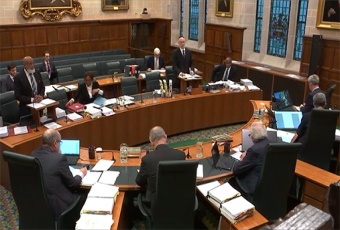
LONDON, CMC -The London-based Judicial Committee of the Privy Council Monday unanimously dismissed an enchantment filed by a public officer, Terrisa Dhoray, saying that the Trinidad and Tobago Income Authority Act doesn’t breach the Structure.
“We received the case. This required super effort in opposition to the relentless opposition from the UNC(United Nationwide Congress) and the PSA (Public Service Affiliation). Now we will modernize income assortment,” Trinidad and Tobago’s Finance Minister Colm Imbert stated in a short assertion following the Privy Council ruling.
Woman Simler, who delivered the unanimous judgment of the Privy Council, Trinidad and Tobago’s highest and remaining courtroom, stated the proper method on this enchantment is to concentrate on the rationale or objective of chapter 9 of the Structure.
The five-member Privy Council stated additionally it is to concentrate on the protections for public officers, which it accommodates to find out whether or not devolving tax features to the Authority contradicts its phrases or the assumptions on which it’s primarily based.
“That is preferable to the method taken by the Court docket of Enchantment, which sought to tell apart between core governmental features, which should be carried out by public officers, and different governmental features, which might be transferred,” the Privy Council dominated.
The Trinidad and Tobago Income Authority Act, Act No 17 of 2021, was handed by the Parliament of Trinidad and Tobago by a easy majority in 2021 and obtained the President’s permission on 23 December 2021.
The Act creates the Trinidad and Tobago Income Authority (TTRA), a brand new, semi-autonomous physique whose features have been carried out by the Inland Income Division and the Customs and Excise Division, each departments of central authorities within the Ministry of Finance.
Workers presently employed in these Divisions are designated as “public officers” beneath the 1976 Structure of the Republic of Trinidad and Tobago. This entitles them to sure constitutional protections beneath Chapter 9 of the Structure.
These embody vesting the facility to nominate public officers within the Public Service Fee, which additionally has the facility to advertise, take away, and train disciplinary management over public officers employed within the authorities. Utilizing the Public Service Fee and Chapter 9 safety, public officers are immunized from improper political strain and interference.
Below the Act, a major proportion of employees employed to discharge the income features devolved to the TTRA won’t be “public officers” throughout the which means of the Structure and won’t appeal to Chapter 9 safety.
Dhoray, a Customs and Excise officer, had introduced a declare within the Excessive Court docket in opposition to the Trinidad and Tobago authorities looking for a declaration that the Act is inconsistent with the Structure as a result of it devolves income features to the Authority to be carried out by personal workers, slightly than public officers.
The Excessive Court docket dismissed the appellant’s declare. She appealed to the Court docket of Enchantment, which upheld the Excessive Court docket’s determination.
In its ruling on Monday, the Privy Council unanimously dismissed the appellant’s enchantment, holding that the TTRA Act doesn’t breach the Structure.
Woman Simler stated that the rationale for shielding Chapter 9 is twofold.
First, the Structure’s impartial Service Commissions are composed, structured, and controlled to make sure that public officers are impartial and immune from political strain.
The Privy Council stated the aim of giving public officers safety of tenure and safety from political interference in choices on appointment, switch, and promotion is to guard them from the political affect or interference to which they’d in any other case be weak by the federal government of the day.
Secondly, the general public is protected against political interference by having a cadre of public servants who can act independently of any specific authorities. In each circumstances, the danger to public servants and the general public arises from these public officers being institutionally a part of authorities and topic to the course of ministers.
Nonetheless, the Privy Council famous that the Structure doesn’t expressly require that core authorities features be carried out or delivered solely by public officers coated by Chapter 9.
In contrast, part 74(3) of the Structure is in keeping with the Structure authorizing Parliament to switch government features to individuals apart from the President.
The Privy Council famous that Chapter 9’s rationale is to guard public officers and, not directly, the general public from improper political strain as a result of public officers are institutionally a part of the federal government. If the operate carried out by such officers is faraway from authorities and put into the arms of a separate statutory physique, there isn’t a longer any want for these protections, supplied that two situations are happy.
First, the separate statutory physique should be impartial, not a tool or a sham. Secondly, there should be ample and efficient safeguards to make sure that there’s, actually, independence and ample safety for workers from political interference from the chief [
“In this case, both conditions are met. There is no suggestion that the creation of the Authority was a device or a sham, and there are effective safeguards to protect the staff and officers of the Authority and members of the public from executive interference. Accordingly, the Act is not inconsistent with the Constitution,” the Privy Council ruled.
Related

