

GEORGETOWN, Guyana, CMC – The Guyana authorities says it’s working to finish its written responses to questions raised by the United Nations (UN) Human Rights Committee (HRC) earlier this week.
As well as, Georgetown reminds us that the constitutional framework of a democratic nation like Guyana prohibits the chief from conducting investigations into high-profile issues corresponding to corruption.
The HRC was established to observe the implementation of the Worldwide Covenant on Civil and Political Rights (ICCPR). It’s a physique of unbiased specialists that displays State events’ implementation of the ICCPR.
Earlier this week, Governance Minister Gail Teixeira advised the HRC that nobody had lodged a police criticism concerning the claims made in a US Vice Information report concerning the dearth of investigation into Vice President Bharrat Jagdeo’s alleged corruption.
“There isn’t a follow-up on it as a result of there was no police report made by Vice Information or anyone else, and so the police can’t examine with out some type of report or criticism,” she advised the UN Human Rights Committee, including that Jagdeo had publicly responded to these allegations in media that had carried the problem.
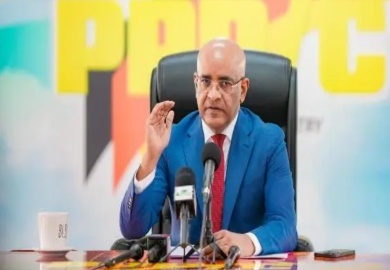
Talking at his weekly information convention on Thursday, Jagdeo expressed concern that Teixeira was not given sufficient time to reply appropriately to the questions posed by the HRC.
“The issue is that for those who ask 70 questions and don’t give us time to reply, ” Gail Teixeira complained. You requested all these questions. Folks hear all these questions, however they need to additionally hear the solutions…
“We’re engaged on that [report] now, and the responses need to go quickly … each one among these points we’ll handle in writing, and we are going to ask them to publish our responses to the questions – we are going to publish them too,” Jagdeo added.
He additionally questioned the failure of particular native non-governmental organizations (NGOs) to make their shadow submissions to the committee publicly.
“[There are] not many international locations that permit particular person complaints … The US and the UK don’t. Now we have allowed that to occur. We need to see all of the submissions for transparency functions. You may see our submission from the Authorities. It is a physique that enhances nice transparency, so it ought to be clear on the way it works, too,” Jagdeo mentioned.
He mentioned that a few of the points raised by the HRC have been just like the “unsubstantiated narrative” by opposition legislators, who’ve accused the current administration of wrongdoings since 2020.
“They [the opposition] can’t discover resonance right here in Guyana; no person pays consideration to them … so that they go to the worldwide our bodies,” he mentioned.
Jagdeo insisted that each one the allegations and issues introduced up earlier than the Authorities had comprehensively addressed the HRC in its third Worldwide Covenant on Civil and Political Rights (ICCPR) report.
In 2020, Guyana was requested to submit its ICCPR report, which was subsequently submitted in 2021. The report detailed the Authorities’s advances in civil and political rights.
“We’ve addressed problems with corruption, election rigging, and so forth., all of that are addressed in our major submission,” he added.
In the meantime, Legal professional Normal and Minister of Authorized Affairs Anil Nandlall, SC, has mentioned that the constitutional framework of a democratic nation like Guyana prohibits the chief from conducting investigations into high-profile issues corresponding to corruption.
He mentioned that this energy is delegated to legally instituted semi-autonomous our bodies as he responded to remarks made by america consultant on the HRC, Laurence Helfer, concerning the Guyana authorities’s alleged failure to analyze corruption studies involving the vice chairman, judiciary, and police.
Nonetheless, Nandlall mentioned that Helfer’s query validates his misunderstanding and unacquaintance with Guyana’s authorized structure.
“You’ve the Guyana Police Drive, you may have the Auditor Normal’s Workplace, you may have the Guyana Income Authority…All these businesses aren’t authorities businesses; they’re state businesses. The people who find themselves asking these questions are unacquainted with and never educated about our governance construction,” Nandlall mentioned.
He mentioned that if the top of state needed to examine the judiciary, the nation could be in turmoil, and the Authorities could be severely criticized.
“You’ll hear…that the chief interferes with the judiciary, that [the] government is pressuring the judiciary. You’ll hear about undermining and violating the doctrine of separation of powers…But you may have an individual who doesn’t perceive these ramifications.”
Nandlall challenged Helfer’s assertion that the general public was pissed off with the non-investigation of corruption claims.
“Which section of the general public is pissed off by this allegation?” he questioned, including that solely members of the principle coalition opposition, A Partnership for Nationwide Unity and Alliance for Change (APNU+AFC), are pursuing these allegations within the public area, pushed by political self-interest. He mentioned that this similar political tactic was unleashed pre-2015, main as much as the overall and regional elections.
Associated

