

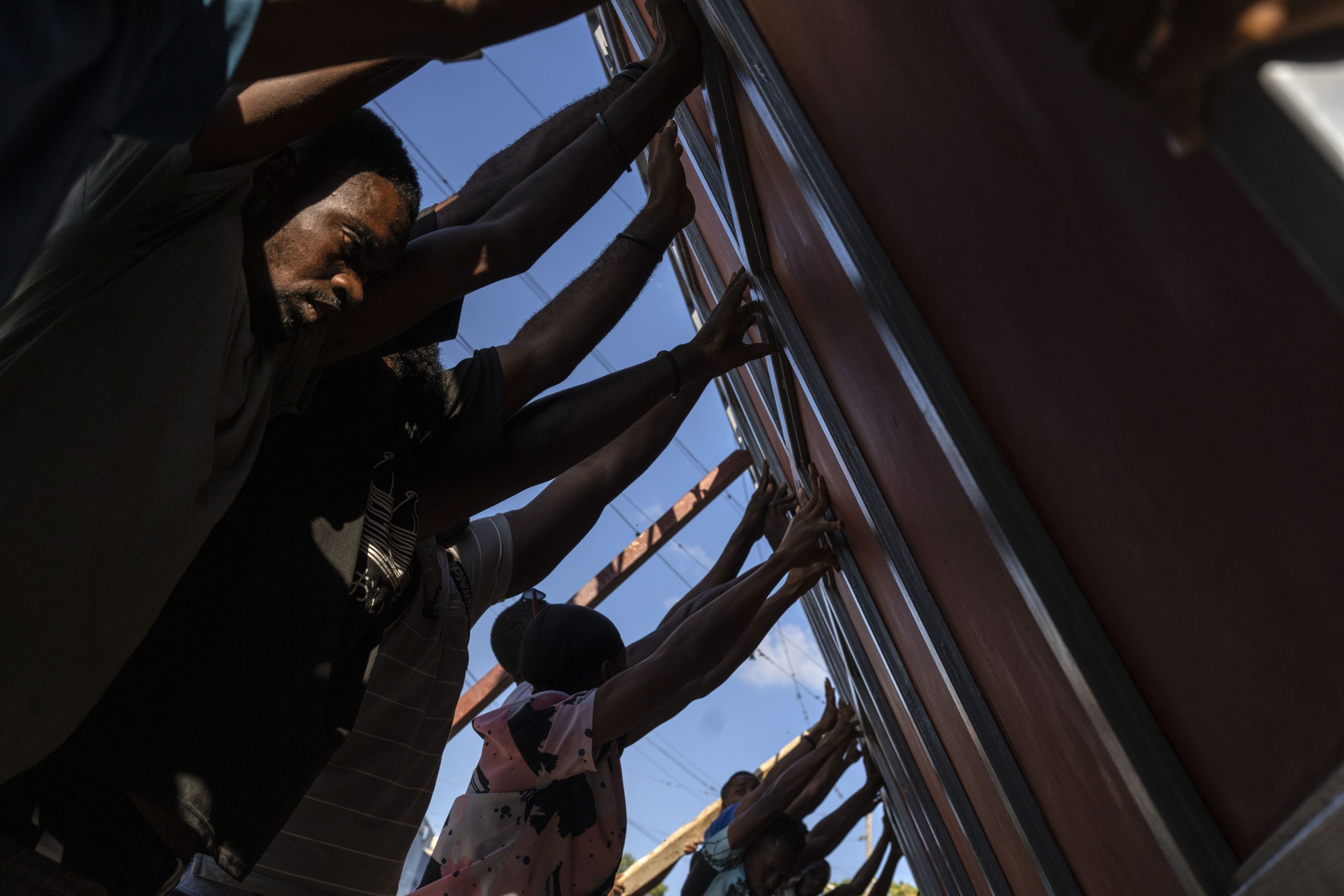
PORT-AU-PRINCE, Haiti (AP) — Because the solar units, a burly man bellows right into a megaphone whereas a curious crowd gathers round him. Subsequent to him is a small cardboard field with a number of banknotes value 10 Haitian gourdes — about 7 U.S. cents.
“Everybody give no matter they’ve!” the person shouts as he grabs the arms and arms of individuals coming into a neighborhood within the capital of Port-au-Prince that has been focused by violent gangs.
The group lately voted to purchase a steel barricade and set up it themselves to attempt to defend residents from the unrelenting violence that killed or injured greater than 2,500 individuals in Haiti from January to March.
“Daily I get up and discover a useless physique,” mentioned Noune-Carme Manoune, an immigration officer.
Life in Port-au-Prince has develop into a sport of survival, pushing Haitians to new limits as they scramble to remain protected and alive whereas gangs overwhelm the police and the federal government stays largely absent. Some are putting in steel barricades. Others press arduous on the fuel whereas driving close to gang-controlled areas. The few who can afford it stockpile water, meals, cash and drugs, provides of which have dwindled because the principal worldwide airport closed in early March. The nation’s greatest seaport is essentially paralyzed by marauding gangs.
“Individuals dwelling within the capital are locked in, they’ve nowhere to go,” Philippe Branchat, Worldwide Group for Migration chief in Haiti, mentioned in a current assertion. “The capital is surrounded by armed teams and hazard. It’s a metropolis underneath siege.”
Telephones ping usually with alerts reporting gunfire, kidnappings and deadly shootings, and a few supermarkets have so many armed guards that they resemble small police stations.
Gang assaults used to happen solely in sure areas, however now they’ll occur wherever, any time. Staying dwelling doesn’t assure security: One man enjoying along with his daughter at dwelling was shot within the again by a stray bullet. Others have been killed.
Faculties and fuel stations are shuttered, with gasoline on the black market promoting for $9 a gallon, roughly thrice the official worth. Banks have prohibited prospects from withdrawing greater than $100 a day, and checks that used to take three days to clear now take a month or extra. Cops have to attend weeks to be paid.
“Everyone seems to be underneath stress,” mentioned Isidore Gédéon, a 38-year-old musician. “After the prison break, individuals don’t belief anybody. The state doesn’t have management.”
Gangs that management an estimated 80% of Port-au-Prince launched coordinated assaults on Feb. 29, concentrating on essential state infrastructure. They set hearth to police stations, shot up the airport and stormed into Haiti’s two greatest prisons, releasing greater than 4,000 inmates.
On the time, Prime Minister Ariel Henry was visiting Kenya to push for the U.N.-backed deployment of a police force. Henry stays locked out of Haiti, and a transitional presidential council tasked with choosing the nation’s subsequent prime minister and Cupboard may very well be sworn in as early as this week. Henry has pledged to resign as soon as a brand new chief is put in.
Few consider this may finish the disaster. It’s not solely the gangs unleashing violence; Haitians have embraced a vigilante movement known as “bwa kale,” that has killed a number of hundred suspected gang members or their associates.
“There are particular communities I can’t go to as a result of everyone seems to be afraid of everybody,” Gédéon mentioned. “You might be harmless, and you find yourself useless.”
Greater than 95,000 individuals have fled Port-au-Prince in a single month alone as gangs raid communities, torching properties and killing individuals in territories managed by their rivals.
Those that flee by way of bus to Haiti’s southern and northern areas danger being gang-raped or killed as they move via gang-controlled areas the place gunmen have opened hearth.
Violence within the capital has left some 160,000 individuals homeless, in accordance with the IOM.
“That is hell,” mentioned Nelson Langlois, a producer and cameraman.
Langlois, his spouse and three youngsters spent two nights mendacity flat on the roof of their dwelling as gangs raided the neighborhood.
“Time after time, we peered over to see after we might flee,” he recalled.
Compelled to separate up due to the dearth of shelter, Langlois resides in a Vodou temple and his spouse and kids are elsewhere in Port-au-Prince.
Like most individuals within the metropolis, Langlois normally stays indoors. The times of pickup soccer video games on dusty roads and the nights of consuming Status beer in bars with hip-hop, reggae or African music enjoying are lengthy gone.
“It’s an open-air jail,” Langlois mentioned.
The violence has additionally pressured companies, authorities businesses and colleges to shut, leaving scores of Haitians unemployed.
Manoune, the federal government immigration officer, mentioned she has been incomes cash promoting handled water since she has no work as a result of deportations are stalled.
In the meantime, Gédéon mentioned he not performs the drums for a dwelling, noting that bars and different venues are shuttered. He sells small plastic baggage of water on the road and has develop into a handyman, putting in followers and fixing home equipment.
Even college students are becoming a member of the workforce because the disaster deepens poverty throughout Haiti.
Sully, a tenth grader whose college closed practically two months in the past, stood on a road nook locally of Pétion-Ville promoting gasoline that he buys on the black market.
“You need to watch out,” mentioned Sully, who requested that his final title be withheld for security. “Throughout the morning it’s safer.”
He sells about 5 gallons every week, producing roughly $40 for his household, however he can’t afford to affix his classmates who’re studying remotely.
“On-line class is for individuals extra lucky than me, who’ve more cash,” Sully mentioned.
The European Union final week introduced the launch of a humanitarian air bridge from the Central American nation of Panama to Haiti. 5 flights have landed within the northern city of Cap-Haïtien, site of Haiti’s sole functioning airport, bringing 62 tons of medication, water, emergency shelter gear and different important provides.
However there is no such thing as a assure that essential objects will attain those that most want them. Many Haitians stay trapped of their properties, unable to purchase or search for meals amid whizzing bullets.
Aid groups say nearly 2 million Haitians are on the verge of famine, greater than 600,000 of them youngsters.
Nonetheless, persons are discovering methods to outlive.
Again within the neighborhood the place residents are putting in a steel barricade, sparks fly as one man cuts steel whereas others shovel and blend cement. They’re effectively underway, and hope to complete the undertaking quickly.
Others stay skeptical, citing studies of gangs leaping into loaders and different heavy gear to tear down police stations and, extra lately, steel barricades.
