

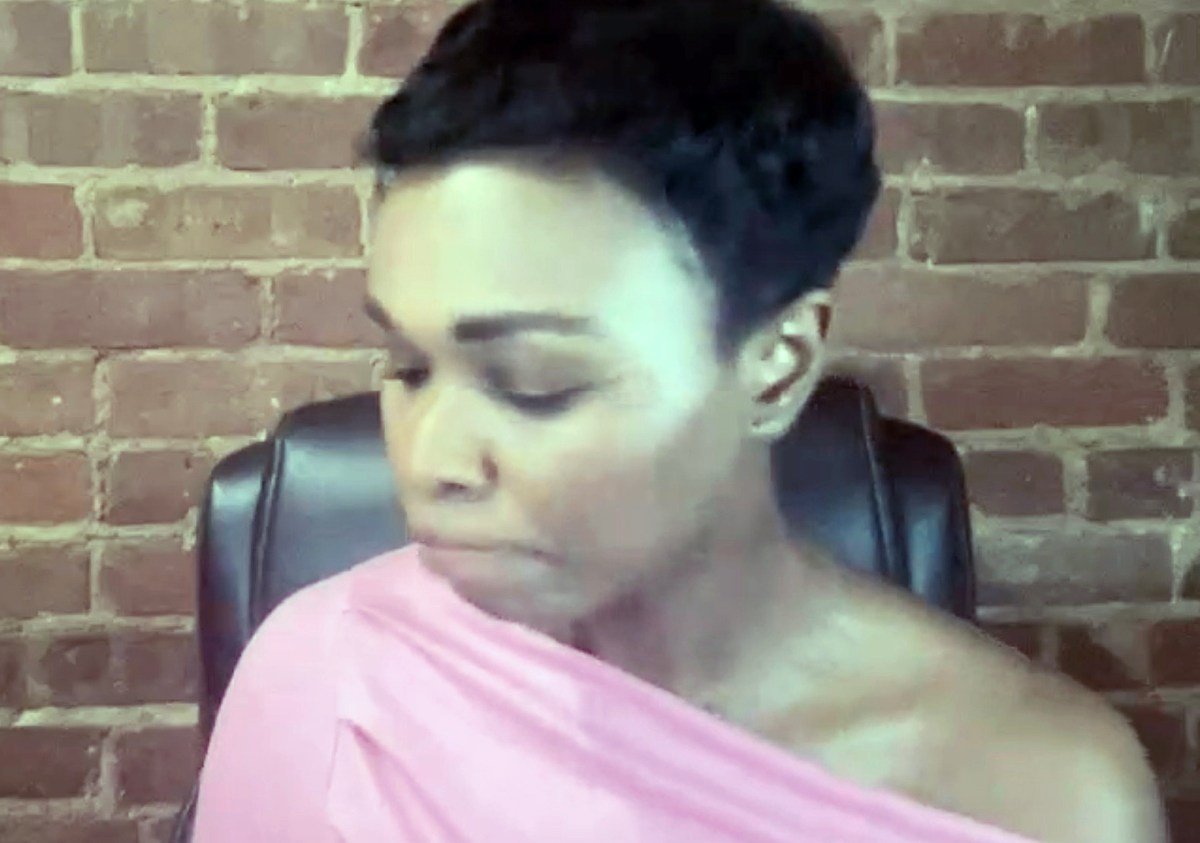
On Jan. 9, Nigerian American journalist Rita Omokha (pronounced O-mo-cah) mentioned her debut ebook, “Resist: How a Century of Younger Black Activists Formed America” (St. Martin’s Press/MacMillan, 2024), in a digital dialog hosted by the Queens Public Library (QPL).
Omokha was motivated to write down the ebook after George Floyd’s dying on Might 25, 2020, 5 days after graduating from Columbia College’s Graduate College of Journalism along with her Masters of Science (M.S.) in Journalism. She is now an adjunct professor of Journalism there.
An excerpt of the ebook abstract on MacMillan’s web site states, “Rita charts the final century of civil rights activism, from the early years of famend activist Ella Baker and others she impressed, … all the best way to the present technology of younger Black revolutionaries who walked American cities within the wake of the murders of numerous Black individuals. Rita additionally attracts on her experiences as a Black immigrant dwelling in America, providing a novel and insightful perspective on this ongoing battle for justice.
Omokha got here to the States when she was very younger. Though her reminiscence of house is foggy, she does keep in mind rising up in Benin Metropolis and having “a spirited, community-focused life filled with household gatherings, traditions, and respect for elders.” That sense of connection and tradition formed her childhood.
When sharing essentially the most vital influences on her profession path, Omokha said, “I stand on the shoulders of so many, from all those that have been within the trenches with me, my mentors and brokers, to important assist programs akin to my neighborhood at The Father’s Coronary heart Ministries (an incredible nonprofit doing a lot for the NYC neighborhood).”
The primary ebook that sparked her curiosity in writing and made her see the worth in her voice was “Their Eyes Had been Watching God” by Zora Neale Hurston. For her, it was a magical, transformative ebook as a result of Hurston’s use of damaged English made her really feel so seen as somebody who spoke damaged English (often called Pidgin English in Nigeria).
“My Christian religion has additionally been my foremost north star. It’s one factor to have a imaginative and prescient and calling; it’s one other to behave on it. I thank God day by day — I’m not being hyperbolic — that I get to do what I do, however it’s solely as a result of I used to be risk-tolerant sufficient to step out on religion and depend on God for sustenance,” she added.
Omokha knew she wished to pursue a profession as a journalist and now an creator since she was very younger.
“I’ve at all times wished to be a storyteller. Studying Hurston’s phrases all however cemented that for me in highschool. I’m a reporter at coronary heart — I believe most authors have the elemental talent set required to be a profitable journalist—and I at all times knew I might need to increase that into varied genres and inform tales of the susceptible and people systematically neglected in society,” she continued.
Omokha shared how she typically felt torn between my two main worlds—encased inside her Nigerian bubble at residence whereas typically misplaced amongst People, particularly Black People, who had a unique historical past and set of experiences.
“There have been moments once I felt I needed to show my Blackness or the place I fearful that my immigrant background made me a perpetual outsider, particularly within the combat for racial justice. Might I even communicate on it? Was I allowed? Navigating ideas like that may very well be conflicting,” she defined.
“Black People and Black immigrants every carry precious views, and whereas our histories could differ, we face most of the identical challenges and systemic limitations in America,” she added.
She hopes, partly, that the ebook showcases that there’s power in our variety — and that by supporting one another, we will create a extra inclusive imaginative and prescient of Black id that embraces all of us.
As well as, Omokha stated doing analysis for the ebook helped deepen her appreciation and love for Black America, as she and her brothers have been raised right here.
“We have been true latchkey children with all our goings and comings, and it was our neighbors who regarded out for us. So, in some ways, I hadn’t absolutely appreciated how a lot they’d our backs. When you’re steeped in one thing, it’s onerous to know its full relevance—to attach the dots of how important it’s. You possibly can solely join the dots trying again; Resist helped me do this,” she stated.
In 2020, victims of racism and police brutality included George Floyd (died on Might 25), Breonna Taylor (died on March 13), and Ahmaud Arbery (died on Feb. 23). Omokha shared how not possible it’s for her to share a message of hope each time this occurs to Black individuals.
“Each time a brand new title is added to that dreadful checklist, it looks like we’re all dragged again to sq. one. It’s exhausting, and for the households—the survivors—it amplifies their personal trauma, reopening wounds that haven’t had the prospect to heal,” she said.
Based on Omokha, the method of writing the ebook revealed that we aren’t paying sufficient consideration to the teachings of historical past collectively.
“Historical past doesn’t repeat itself; we’re simply ignoring its classes. It’s meant to be our information. It’s meant to be known as upon. None of that’s taking place. Consequently, we’re caught in a cycle of deliberate subjugation—even nonetheless—by some within the majority. The one distinction from yesteryear is that its type has merely shifted. So, it’s onerous to really feel a way of hope. However like Lincoln as soon as stated, I am an optimist; I don’t see the purpose in being anything. We have to all lean on that on this season of America,” she defined.
Omokha then spoke in regards to the ebook’s affect on the individuals in her neighborhood and her college students.
“Whereas society continues to evolve from the age of agriculture to the commercial and knowledge ages, what stays one of the best instructor is historical past. That’s what I walked away with—that’s what the younger individuals I cowl educate us: that the liberty now we have right this moment wasn’t free, that our democracy is valuable and is price defending,” she continued.
Moreover, she spoke in regards to the affect of ebook bans in a number of states across the nation and the way they affect the youthful technology.
“Guide bans restrict their publicity to various concepts and important considering. It limits their instructional progress. By proscribing entry to sure books — to sure truths — college students miss the chance to have interaction with complicated themes and totally different views, that are essential for creating analytical expertise, for instance.”
In the neighborhood, these bans additional slim the vary of literary voices and concepts, stifling open dialogue and lowering engagement with nationwide and worldwide literature,” Omokha defined.
She hopes the ebook conjures up readers, particularly the rising technology in Nigeria, by showcasing the facility of activism and the significance of standing up for justice, equality, and alter. She additionally hopes it serves as a software for cultivating management, resilience, and a dedication to optimistic change of their lives and communities.
“By highlighting the tales of unsung younger Black activists and their allies, I hope they, too, can see the facility of their voice and use it as their best weapon and ally. I hope they see that it simply takes one particular person saying sufficient is sufficient to make a distinction of their communities and demand higher instructional assets and assist, no matter their age or background,” she continued.
She added that the ebook can additionally assist them higher perceive international struggles for freedom and equality, encouraging empathy, important considering, and a broader perspective on social points.
“By way of the tales highlighted, I hope they’ll see firsthand that change takes time — that lasting change is incremental — however in the end, change is feasible.”
Omokha is at present researching her second ebook. Though it’s too quickly to talk on it, it has lengthy piqued her curiosity with regards to ethnicity and id.
Instructing is a present for her, and he or she has been honored to do it at Columbia College, which made this journey attainable.
Omokha appears to be like ahead to persevering with to mentor and encourage the subsequent technology of writers and thinkers.
“It’s not nearly imparting data however about encouraging college students to search out their personal voices and belief of their distinctive views,” she added.
Discover all info on the place to buy Resist right here: https://us.macmillan.com/books/9781250290984/resist/.
To remain up to date on Omokha and her work, these can comply with her on her social media platforms, which will be discovered on her web site: https://www.ritaomokha.com/.
To remain up to date on future occasions hosted by QPL, individuals can join their publication on the library web site: https://www.queenslibrary.org/.
