

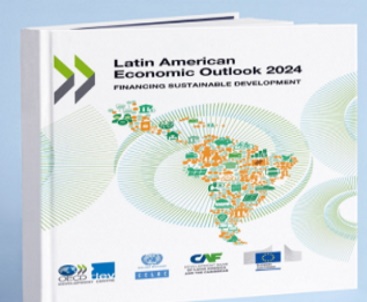
SANTIAGO, Chile, CMC—Latin America and the Caribbean (LAC) international locations ought to strengthen tax assortment and spending, enhance public debt administration, and mobilize extra non-public sources to finance their bold improvement agendas, in response to the newest version of the Latin America Financial Outlook (LEO).
The LEO is collectively produced by the Growth Centre of the Organisation for Financial Cooperation and Growth (OECD), the United Nations Financial Fee for Latin America and the Caribbean (UN-ECLAC), the CAF-Growth Financial institution of Latin America and the Caribbean, and the European Fee.
The 2024 version, titled “Financing Sustainable Growth,” contends that LAC’s sustainable financing hole, estimated at US$99 billion yearly, could be bridged if non-public and public actors enhance coordination with the help of their worldwide companions.
It stated that the area’s difficult socioeconomic context requires an bold set of reforms. Productiveness development stays weak, with common labor productiveness amounting to simply 33 % of OECD ranges in 2023. Poverty accounted for 27.3 % of the area’s complete inhabitants in 2023, its lowest degree over the previous 20 years.
Excessive poverty has remained persistently excessive, affecting one out of 10 or 10.6 % of Latin American and Caribbean populations.
Many international locations keep a good financial stance to maintain inflation expectations anchored and are present process a fiscal consolidation section after the area’s budgetary area decreased considerably following the COVID-19 pandemic. On this context, there’s little area for expansionary financial insurance policies to help mixture demand and social targets.
The report consists of numerous precedence measures to mobilise sources in pursuit of LAC’s sustainable improvement, together with enhancing tax levies.
It stated that in most LAC economies, tax revenues are low, with a median of 21.5 % of gross home product (GDP) in 2022, in comparison with the OECD’s 34 %. Moreover, adjusting the tax construction or leveraging present taxes may assist cut back inequalities, help the inexperienced transition, enhance well being outcomes, and foster entrepreneurship.
The report additionally requires LAC to optimise funds allocation and enhance spending effectivity to liberate extra sources. It stated public spending is concentrated in present expenditures, equivalent to wages and transfers (82 % in 2023), short-term-focused, and ineffectively allotted.
The doc requires enhancing debt administration by sturdy fiscal frameworks to keep up fiscal sustainability.
It stated LAC international locations have seen their debt service enhance from 9.8 % of tax income in 2012 to 12.2 % in 2022.
Over the previous decade, curiosity funds in a number of international locations have been as much as twice the spending on schooling, thrice that on healthcare, and 4 instances that on capital expenditure.
There’s additionally a must deepen monetary markets and encourage innovation to channel extra non-public sources in direction of improvement targets. In LAC, monetary programs want extra depth, with home credit score to the non-public sector reaching 50 % of GDP.
Monetary programs nonetheless exclude some weak teams, together with ladies. In 2020, shut to fifteen % of formal households had entry to housing loans in comparison with simply 2.3 % of casual households.
The report encourages manufacturing transformation to attain sustainable development and promote aggressive sectors by growing the presence of personal issuers and enhancing capital market liquidity. At present, debt markets within the LAC area are largely public-sector-driven, accounting for 81 % of native issuances from 2015 to 2023. To handle this focus, the report says insurance policies ought to intention to increase institutional investor participation, replace regulatory frameworks, enhance monetary literacy, and strengthen regional integration.
It stated improvement finance establishments (DFIs) play a key function in a monetary market that’s nonetheless growing. Thirty-four % of DFIs have a selected mandate to help the financial inclusion of micro, small, and medium-sized enterprises. Nonetheless, solely 19 % of the monetary devices they suggest tackle the inexperienced transition, gender equality, and digital transformation or innovation.
The report notes that worldwide cooperation is essential to mobilizing new sources, together with the EU-LAC World Gateway Funding Agenda, which mobilizes funding by public-private partnerships to handle infrastructure wants whereas creating native added worth and selling development, jobs, and social cohesion.
It stated financing devices like inexperienced, social, and sustainability-linked bonds proceed to be engaging mechanisms, growing from 9.3 % of complete LAC bond issuance in worldwide markets in 2020 to virtually 35 % in 2023.
Disaster bonds, debt-for-nature swaps, and pure catastrophe clauses can mobilize private and non-private funding the place wants are biggest. Establishing harmonized frameworks and dependable monitoring and supervision mechanisms for these devices ought to stop greenwashing.
Lastly, the area ought to coordinate to current its personal regional perspective on the UN’s Fourth Worldwide Convention on Financing for Growth, which can be held in mid-2025 in Sevilla.

