

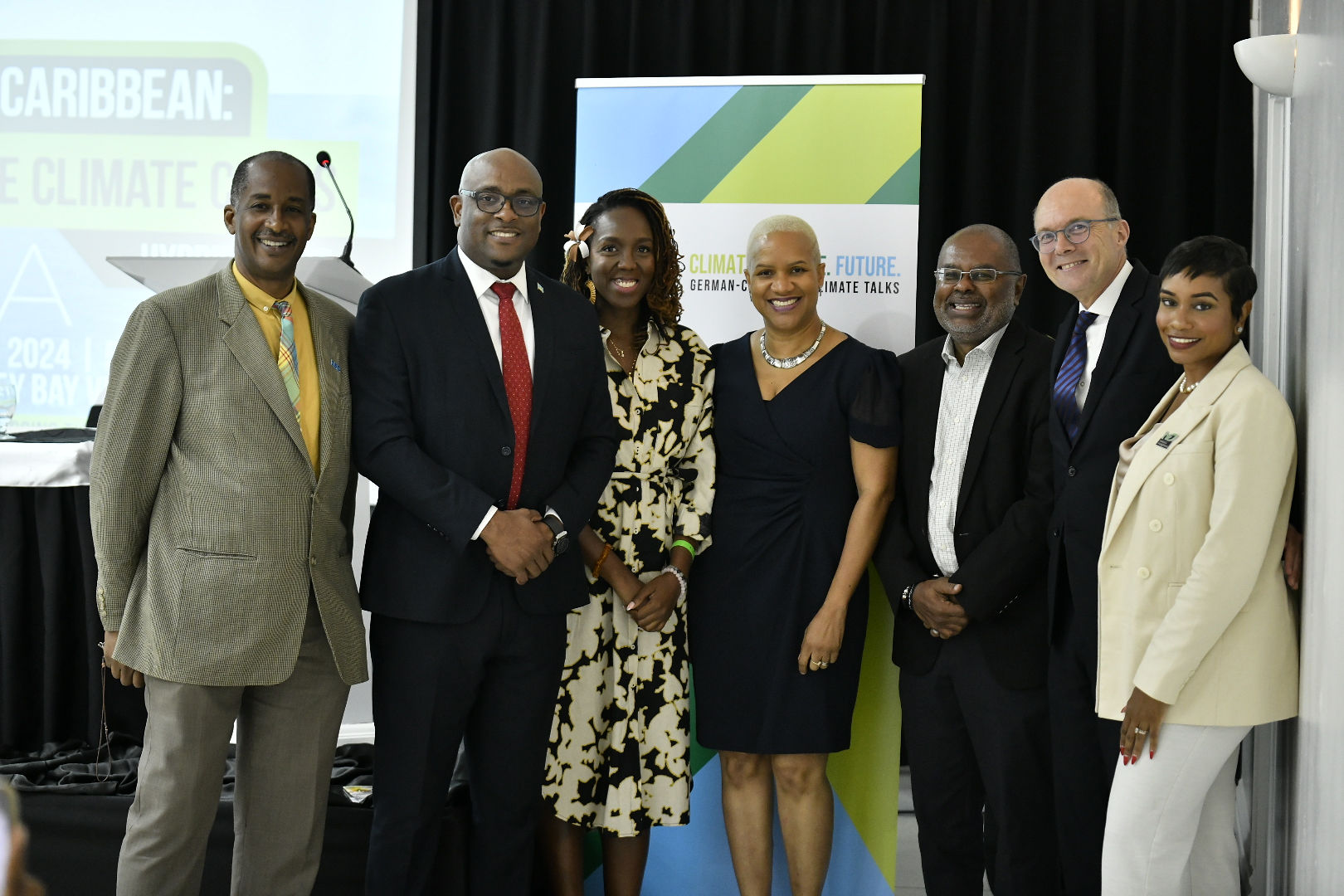
St. Lucia was the positioning of the second version of the German – Caribbean Local weather Talks, the place authorities officers and dignitaries examined options to urgently deal with devastating local weather change impacts within the Caribbean
On the Germany – Caribbean Local weather Talks occasion, “Loss and Injury within the Caribbean: The Toll of the Local weather Disaster”, senior officers from St. Lucia and Germany agreed that the highly-celebrated loss and harm fund to deal with worsening local weather change impacts is now liable to being severely underfunded, and worldwide cooperation on this challenge is now a matter of urgency significantly for the Caribbean.
Hosted by German Ambassador Dr. Christophe Eick, Particular Envoy for Local weather Points within the Caribbean, the occasion was held in St. Lucia on Tuesday and featured Shawn Edward, Minister for Training, Sustainable Growth, Innovation, Science, Know-how and Vocational Coaching, Authorities of St. Lucia. The occasion was facilitated in collaboration with Local weather Analytics Caribbean.
The occasion was of explicit significance because of the landmark settlement ultimately yr’s United Nations local weather change negotiations, COP28, to ascertain a loss and harm fund to particularly deal with local weather change impacts which cannot be mitigated or tailored to. This was a historic achievement for the Caribbean area, as officers from St. Lucia and different islands had been instrumental to the thirty-year struggle to create this funding facility to assist susceptible international locations.
Nonetheless, nearly one yr later, many international locations are warning that the capitalization of the fund – which is comprised of roughly $661 million in nation pledges – is much past the trillions wanted to successfully deal with loss and harm. At COP29 this yr, the institution of a New Collective Quantified Aim on local weather finance (NCQG) in addition to the correct funding and operationalisation of the loss and harm fund will take heart stage.
“Germany has been an early advocate of the Loss and Injury fund and has already dedicated $100 million to the fund,” famous Dr. Eick. “Nationwide efforts to deal with loss and harm stay important. In the meantime, susceptible international locations ought to proceed to spend money on Local weather Threat Insurance coverage, and thru these amenities important payouts had been made to susceptible international locations after Hurricane Beryl. Essentially, the largest contribution a rustic like Germany can do is to restrict and cease emitting greenhouse gases which exacerbate local weather change.”
“Our want for monetary assets, additional to know-how switch and capability constructing, to assist our planning and restoration efforts from local weather associated occasions is rising,” stated Minister Edward. “The continual pattern of rising temperatures is impacting our lives, livelihoods, our meals and water safety. The upcoming COP, dubbed the ‘Local weather Finance COP’, will deliver the difficulty of implementation and tangible local weather motion into sharp focus. We want assist from important improvement companions, we’d like world and decisive management on local weather finance, and we’d like it now.”
“St. Lucia continues to steer by instance, investing in renewable power. Just lately, our authorities accepted an Power Coverage for 2023-2030 which fulfils our NDC commitments, underscores our dedication to strengthening power safety, and reduces provide prices. We’ve got additionally enacted laws in that regard, with the Local weather Change invoice changing into legislation in St. Lucia this yr.”
Rueanna Haynes, Director of Local weather Analytics Caribbean, famous that Local weather Analytics Caribbean is at present conducting an in depth report on loss and harm particularly within the Caribbean, with the intention of enhancing the obtainable knowledge and higher supporting regional governments.
“Loss and harm is being reported typically as an ‘financial loss’, demonstrating that there’s a hole in how we within the area are understanding and reporting about loss and harm,” stated Ms. Haynes. “We have to develop a standard regional method for loss and harm reporting. This may deepen regional coordination and help in accessing extra funding for our area.”
Crispin d’Auvergne, Local weather Change and Catastrophe Threat Administration Coordinator of the Organisation of Japanese Caribbean States (OECS), reiterated that loss and harm goes past financial loss.
“For the Caribbean, improved and broader evaluation of loss and harm is crucial, as how will we worth our archaeological websites, or coral reefs? Presently the loss and harm fund is capitalised far under what’s required. A suggestion is {that a} share of the fund be invested in parametric protection. We look ahead to pursuing a relationship with Germany on tailoring approaches for the distinctive wants of OECS international locations.”
The occasion additionally featured Dr. James Fletcher, Chairman of the Govt Board of the Caribbean Centre for Renewable Power, who was a key champion within the decades-long struggle for a loss and harm fund throughout the UN local weather change negotiations.
“What we acquired final yr, as promising and spectacular because it was, solely characterize 0.2% of what’s required on an annual foundation for the Caribbean,” famous Dr. Fletcher. “The annual adaptation prices in growing international locations are within the vary of US$ 160-340billion – we’re well beyond the $100billion requirement. The estimates of the annual price of loss and harm in growing international locations alone amounted to not less than $435 billion in 2020, a determine that’s anticipated to rise by 2030.”
The occasion concluded with stirring remarks from Keithlin Caroo-Afrifa, founding father of the civil society organisation, Helen’s Daughters, which helps girls farmers.
“The impacts of local weather change on the human psyche can’t be quantified in {dollars} and cents,” she stated. “Resilience is not only about restoration however about having the assets to proceed to thrive regardless of the challenges we face. CSOs are left to fill gaps utilizing restricted donor funding to assist catastrophe reduction and restoration, which isn’t sustainable in the long run. CSOs play a significant position in advocating for the wants of marginalized communities, if we aren’t adequately included within the decision-making processes, the ensuing insurance policies might fail to deal with the realities on the bottom.”
Negotiations on local weather finance and the loss and harm fund resume at COP29 in Baku, Azerbaijan, from Nov. 11– 22.
