

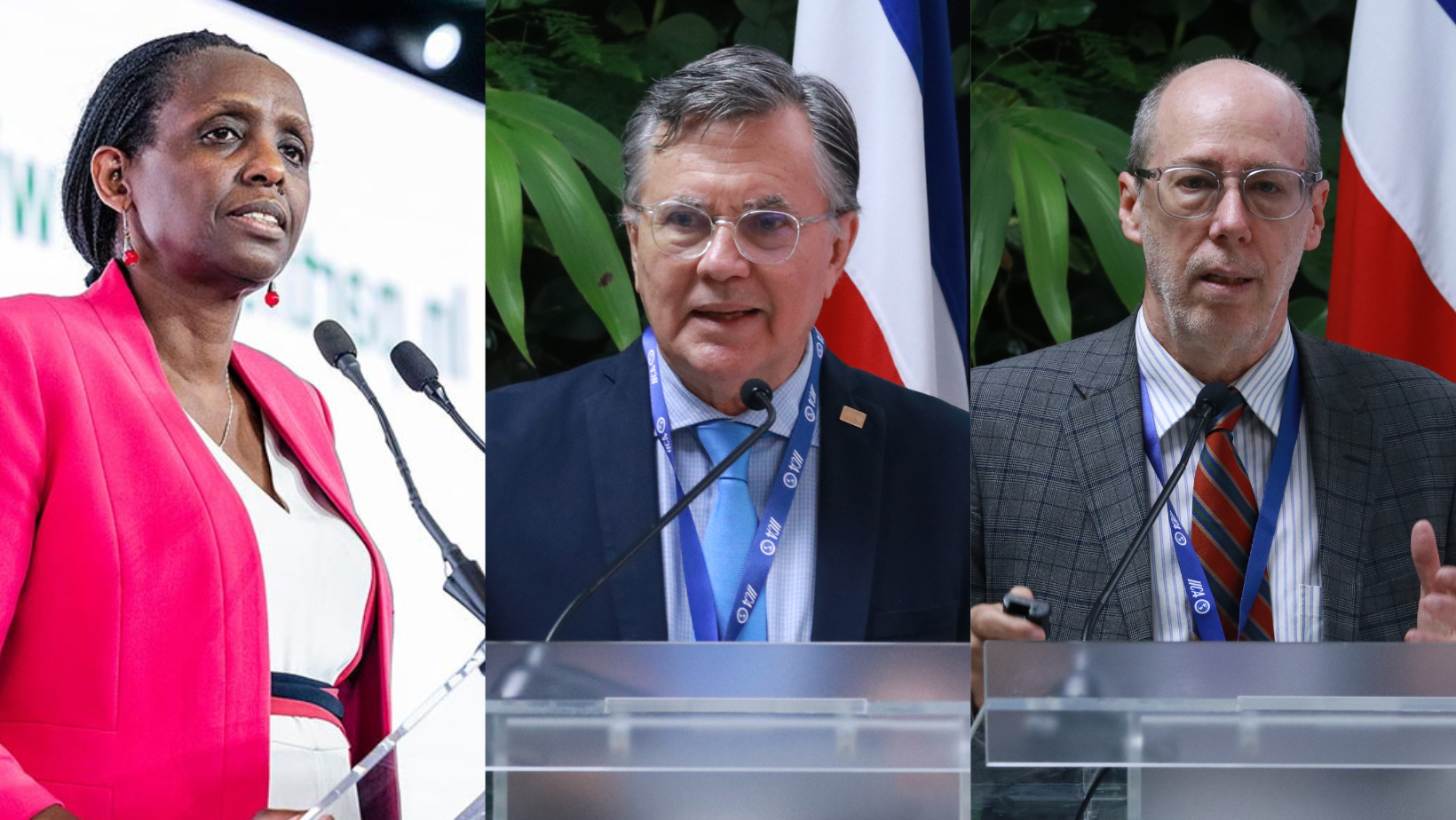
The Alliance for a Inexperienced Revolution in Africa (AGRA) and the Inter-American Institute for Cooperation on Agriculture (IICA) have underscored their choice to work collectively to reinforce the position of Africa and Latin America and the Caribbean as territories which might be key to guaranteeing the planet’s meals safety and environmental sustainability.
Agnes Kalibata, President of AGRA, and Manuel Otero, Director Normal of IICA, took half in an internet dialogue with Jack Bobo, Director of the Meals Methods Institute on the College of Nottingham, in the UK, by which all three agreed that the 2 continents have to deepen their reciprocal collaboration and that agriculture ought to be seen as a part of the answer to the challenges going through humanity; and never just for tackling the issue of meals safety, but additionally for the power transition that’s underway.
AGRA is a corporation that works with private and non-private sector actors to enhance the variation of African farmers and their manufacturing techniques to local weather change, to allow them to be extra resilient to excessive climate occasions and hostile circumstances. A former minister of agriculture of Rwanda and the UN Secretary-Normal’s Particular Envoy to the 2021 Meals Methods Summit, Kalibata has spearheaded the establishment since 2014.
Kalibata and Otero determined to arrange a dialogue with Bobo – a professor acknowledged for his modern work in science communication who will probably be receiving the Borlaug CAST Communication Award from the World Meals Prize Basis in Iowa, United States, in October – to handle points associated to the controversy on the path that the transformation of agri-food techniques ought to take.
The educational opened the dialogue by mentioning that agriculture has a big impact on the atmosphere and that, even so, some 800 million individuals, or ten % of the world’s inhabitants, undergo from starvation.
“Ten % of the inhabitants is hungry, and due to that, and due to the false info that circulates, many suppose that agri-food techniques are a part of the issue. However the actuality is that ten % is a a lot smaller proportion than up to now. In lots of regards, issues are going effectively in agriculture, and that’s the reason it is very important talk about the work of AGRA and IICA”, Bobo mentioned.
The specialist underlined the truth that each IICA and AGRA have carried out very useful work to make sure that the dialogue on the way forward for agri-food techniques is now on the high of the worldwide agenda.
Kalibata defined that AGRA had a broad remit for its work in Africa. “We enhance productiveness and sustainability in agriculture, but additionally promote inclusive markets and applicable public insurance policies”, mentioned the Rwandan former minister, who confused the important thing position that applied sciences play in empowering small farmers.
“African agriculture is present process a means of transformation aimed toward attaining better resilience and better manufacturing, not solely to make sure meals safety but additionally to cut back poverty”, she defined.
“We have now to cope with the sturdy affect of local weather change on our continent”, she added, “and we should adapt. We are able to solely do that by engaged on good agricultural practices, underpinned by an appropriate environmental technique”.
Otero mentioned that each AGRA and IICA are dedicated to disseminating science-based good practices amongst household farmers on each continents.
“The Americas are a heterogeneous continent, with each meals exporters and importers. Brazil exports ten {dollars} for each greenback it imports. Caribbean nations, however, barely generate three cents of exports for each greenback they spend on imports. That’s the reason we’ve got the mission of serving as bridges throughout the continent for the switch of applied sciences, at all times paying shut consideration to the worldwide state of affairs”, Otero remarked.
The IICA Director Normal additionally referred to the necessity for governments to deepen actions for better integration between Latin America and the Caribbean and Africa.
“The bodily distance between Africa and Latin America is simply about 2800 kilometers”, he identified. “That’s the similar as the gap between Brasilia and Buenos Aires. Regardless of this bodily proximity, there may be little interplay. Our premise is that we have to look to the longer term and acknowledge that agriculture is the bridge that may unite us, for the reason that two continents are destined to play an more and more decisive position on the earth’s meals safety and environmental sustainability”.
Kalibata underlined the significance of the Declaration on Sustainable Agriculture, Resilient Meals Methods and Local weather Motion, signed over the last United Nations Local weather Change Convention (COP 28) within the United Arab Emirates.
In that doc, 160 nations acknowledged that unprecedented hostile local weather impacts are threatening the resilience of agriculture and the flexibility of many, particularly essentially the most weak, to provide and entry meals within the face of mounting starvation, malnutrition, and financial stresses.
“IICA has a really highly effective voice within the Americas and the identical is true of AGRA in Africa. We have now to work collectively on insurance policies that construct resilience and transitions which might be essential for our communities. Our precedence have to be to make sure that small farmers have entry to applied sciences that allow them to adapt to local weather change and proceed feeding the world”, he concluded.
Bi-regional cooperation
In recent times, IICA and AGRA have solid a partnership primarily based on the idea that the 2 continents face widespread challenges in advancing the transformation of their agri-food techniques and may profit enormously from joint work inside the framework of South-South Cooperation.
Therefore, along with the African Union Improvement Company-New Partnership for Africa’s Improvement (AUDA-NEPAD), they organized the Africa-Americas Ministerial Summit on Agri-food Methods in 2022, which introduced collectively ministers, deputy ministers and consultants within the areas of agriculture, the atmosphere, and science and know-how from each continents at IICA’s headquarters in Costa Rica.
The cooperation efforts intensified this yr when AGRA and IICA launched the joint bi-regional “Dwelling Soils” initiative which, after its profitable rollout within the Americas, is designed to revive degraded land, rehabilitate acidic soils, enhance agricultural and panorama productiveness, and enhance local weather resilience in African agri-food techniques.
The Dwelling Soils of the Americas mission has been underway in a number of nations within the Western Hemisphere for 4 years, spearheaded by IICA and scientist Rattan Lal, thought of the world’s main knowledgeable in soil science.
