

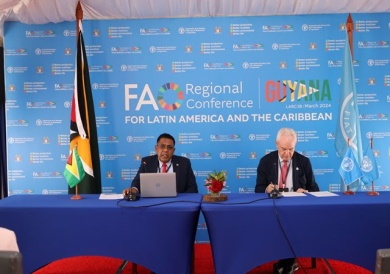
GEORGETOWN, Guyana, CMC -Guyana’s Agriculture Minister Zulfikar Mustapha will chair a process drive established to speed up the implementation of suggestions adopted on the United Nations Meals and Group (FAO) thirty eighth Regional Convention for Latin America and the Caribbean (LARC38), which ended right here on Thursday.
Mustapha can even function LARC’s chairman for the next two conferences.
The regional convention, attended by representatives from 33 nations, mentioned challenges and prime priorities in meals and agriculture, geared toward fostering regional coherence in international insurance policies.
Talking at a information convention on the finish of the four-day convention, Mustapha informed reporters that the outcomes from the occasion can be important in selling sustainable agricultural progress and meals safety in Latin America and the Caribbean.
He stated that the duty drive’s first assembly is anticipated to happen in Might in Chile, the place the suggestions can be additional examined. Guyana is devoted to collaborating with its regional companions to implement the convention’s proposals.
“Over the previous 4 days, now we have witnessed outstanding discussions, collaborations, and insights which have undoubtedly enriched our collective understanding and efforts. All through this convention, now we have delved into essential points affecting our Area, from advancing fisheries and aquaculture in direction of sustainability below the Blue Transformation strategy… lowering starvation and malnutrition for immediately and tomorrow by way of commerce as a strategic driver of meals safety within the area”.
He stated the assembly additionally mentioned agri-food programs transformation in Small Island Growing States (SIDS) in Latin America and the Caribbean, the challenges of the water–forest biodiversity–soil nexus in a local weather change context, and foresight drivers and triggers related to Latin America and the Caribbean.
Delegates have been reported to have recognized many key areas to advance efforts to eradicate poverty and starvation whereas boosting nations’ potential to draw focused investments by way of implementing the Hand in Hand Initiative, launched in 2019 by the FAO.
It helps the implementation of nationally led, formidable packages to speed up agrifood programs transformations by eradicating poverty (SDG1), ending starvation and malnutrition (SDG2), and lowering inequalities (SDG10).
It makes use of superior geospatial modeling and analytics, in addition to a strong partnership-building strategy, to speed up the market-based transformation of agrifood programs, elevating incomes, bettering the dietary standing and well-being of poor and weak populations, and strengthening resilience to local weather change.
The Initiative prioritizes nations and territories the place poverty and starvation are highest, nationwide capacities are restricted, or operational difficulties are most vital because of pure or synthetic crises. Areas of intervention have included:
- Growing worth chains for precedence commodities.
- Constructing agro-industries and environment friendly water administration programs.
- Introducing digital companies and precision agriculture.
- Lowering meals losses and waste.
- Addressing local weather challenges and climate dangers.
In the meantime, Mario Lubetkin, FAO’s Deputy Director Normal and Regional Consultant for Latin America and the Caribbean, stated the convention targeted totally on attaining meals safety.
He additionally disclosed that nations had accepted the regional priorities for remodeling agri-food programs to grow to be extra environment friendly, inclusive, resilient, and sustainable.
“In keeping with the FAO’s Strategic Framework and the dedication to supporting the 2030 Agenda, nations accepted the regional priorities to remodel the agri-food programs to grow to be extra environment friendly, inclusive, resilient, and sustainable. These priorities are interconnected and be sure that nobody is left behind,” he added.
Members additionally acknowledged the essential must strengthen Caribbean resilience, specializing in Small Island Growing States (SIDS), in mild of the quite a few shocks and hazards they confront, particularly the rising hazard posed by local weather change.
Additional, Lubetkin stated the assembly additionally mentioned points referring to the Caribbean Neighborhood’s (CARICOM) 25 by 2025 meals safety agenda, geared toward lowering the Area’s massive meals import invoice by 25 p.c by 2025.
Associated

